Countdown Mortality Transitions
Where countries stand on saving mothers and newborns
When a country gets better at caring for mothers and babies, three things fall together: deaths of mothers, stillbirths and deaths of newborns. Countries tend to move through five phases as this happens, from phase I, where these deaths are most common, to phase V, where they are rare.
This site lets you follow that journey for 151 countries, using UN estimates from 1960 to 2023 and the transition model published in The Lancet Global Health in 2023. You can see where any country stands today, how fast it got there, and how it compares with its neighbours.
About the transition model
The five-phase maternal, stillbirth and neonatal mortality transition model was published in The Lancet Global Health in 2023 by Boerma T., et al. They built it from UN estimates for 151 countries and more than 300 household surveys. Melesse D.Y., et al. then used the model to study Ethiopia's progress, in BMJ Global Health (2024). It places each country in a phase using two measures together: maternal deaths per 100,000 live births, and stillbirths plus newborn deaths per 1,000 births. Each phase has its own key characteristics, described in the Method section. Read more about each phase.
Why it matters. Countries in the same phase tend to share the same causes of death, fertility levels, health workforce, spending and patterns of care at birth. Seeing where a country sits shows how it compares with similar countries, what drove its progress, and what usually has to change to reach the next phase. The 2030 global targets for maternal and newborn deaths (SDG targets: maternal mortality below 70 per 100,000 live births; neonatal mortality 12 or less per 1,000 live births) lie in phase IV, still a long way off for many countries, so a clear view of the path helps governments and partners plan.
See the evidence move
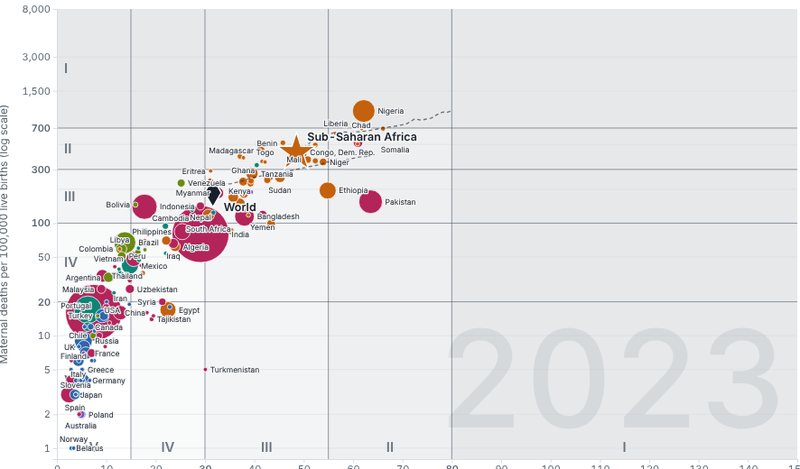 NewTransition Explorer
Watch 151 countries move through five phases of the maternal, stillbirth and newborn mortality transition, 1960 to 2023. View the world or zoom into Africa, pick countries, follow their paths, and compare them with sub-Saharan Africa.
Maternal and newborn health · Live UN estimates · Lancet Global Health transition model
Open the Explorer →
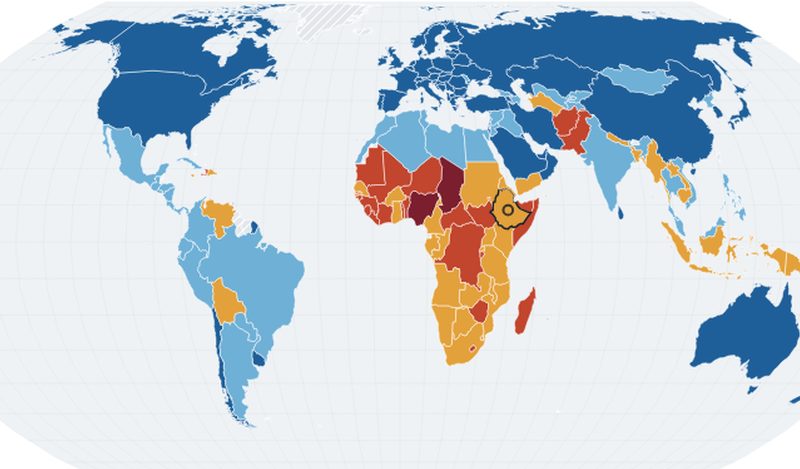 NewTransition Atlas
A living world map of the same transition. Watch countries change colour year by year from 1990, zoom into Africa, and switch to Progress to see who moved fastest since 2000.
Maternal and newborn health · Live UN estimates · 151 study countries, all countries optional
Open the Atlas →
NewInsights
Headline findings for the 151 study countries since 2000: where progress is fastest, where deaths are concentrated and where gains have stalled, measured against the 2030 targets.
Maternal and newborn health · Live UN estimates · Refreshed with one click
Open Insights →
New to the five phases? See how the model works.